
Introduction: Financial Model and Financial Sustainability
When we see a beautiful, modern, and well-planned school, many of us assume that the school may be surviving on the strength of its financial resources.
But in reality, the main reasons behind the school’s success and long-term stability are its (1) Financial Model and (2) Financial Sustainability, meaning a sustainable economic system.
Financial Model
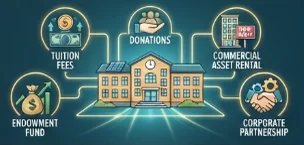
A school is not operated solely on the basis of student fees and donations; rather, it is run with the help of a strong, diversified, and self-sustaining financial ecosystem. If we observe the financial models of top schools closely, we will find that they are generally diversified.
This means that even if a financial problem arises in one particular source of income, revenue continues to flow from other sources. As a result, there is no impact whatsoever on the school’s educational quality, administrative management, or day-to-day operations.
This strong financial model has been divided into three categories based on important methods, namely: (1) The Endowment Fund Model, (2) Commercial Asset Monetization, and (3) Cross-Subsidization and Differential Tuition.
1. The Endowment Fund Model: The main driving force behind the stability and long-term development of top schools is billion-dollar donations from major industrialists, donors, alumni, or trustees.
The school administration does not directly spend these billions of dollars but deposits them into a permanent fund. The money is then invested through experienced fund managers in real estate, bonds, profitable startups, global stock markets, and various other profitable sectors.
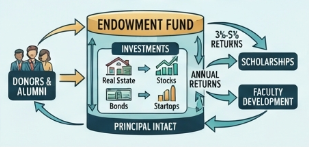
An annual return of approximately (typically 7%-10%) is earned from these investments. Then, 3%-5% of the investment returns is spent on infrastructure for hiring international teachers or faculty, campus renovations, student scholarships, operating modern laboratories, and other developmental infrastructure projects and maintenance work.
As a result, the principal remains intact, and with the investment of the principal alongside the returns generated from the above investments, income continues to flow steadily.
Consequently, even if the school faces an economic crisis or recession at any point, it does not encounter a financial crisis. This system is effective and powerful in maintaining educational quality.
2. Commercial Asset Monetization: Generating additional income by commercially utilizing the assets of renowned schools, such as their own campuses, residential buildings, sports grounds, auditoriums, etc., is an effective financial strategy.
We know that in Britain, during the summer and winter when school campuses are closed or operating partially, school administrations rent out these campuses for global conference halls, classrooms, Hollywood and British film shoots, international summer schools, corporate leadership camp, and so on.

During the off-periods when schools in Britain remain closed, school administrations earn substantial amounts of money through this effective strategy, which is directly added to the school fund as additional revenue.
Many top schools in the United Kingdom currently use this technique to generate substantial revenue. Through these types of commercial activities, schools can utilize their assets to generate income and directly add it to their school funds.
Many schools in the United States also adopt these effective strategies to improve the quality of education, institutional development, and campus renovation, while continuously working to elevate their schools to the top.
3. Cross-Subsidization and Differential Tuition: Cross-subsidization and differential tuition are advanced financial systems through which schools charge full tuition fees to students from extremely wealthy families.

A portion of this revenue is used for “Need-Blind Scholarships,” while another portion is used to provide need-based financial aid, scholarships, and other financial assistance to highly academically gifted, qualified, and talented students, helping the school maintain social balance and remain at the top.
In this system, the school authorities cover the entire cost of education for poor students who are admitted to the school.
Financial Sustainability
How does financial sustainability, or a sustainable economic system, help top schools maintain financial stability? When an economic recession occurs in a country, its impact affects businesses, trade, and even the education sector or that country.
As a result, a school’s financial condition can decline to its lowest level. Financial sustainability is further divided into three categories, namely: (1) Green Infrastructure and ROI, (2) Performance-Based Energy Budgeting, and (3) Corporate CSR Partnerships and Patent Sharing.
The following is a detailed discussion of these three areas:
1> Green Infrastructure and ROI: When a building is constructed, a substantial amount of money must be spent on its construction, water, electricity bills, and other expenses.
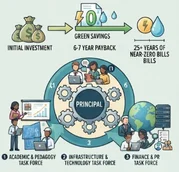
However, when a top school invests a significant amount of money in constructing buildings and covering water and electricity expenses, particularly when top-ranked schools initially invest in geothermal heating/cooling systems, solar grids, rainwater harvesting, and other such technologies, the entire cost of these technologies is recovered within 6 to 7 years.
After that, the school’s electricity and water bills can be reduced to almost zero for the next 25 to 30 years, and the money saved is spent on the school’s technological development.
2> Performance-Based Energy Budgeting: In most cases, it can be observed that top-ranked schools have their own ecosystems for every laboratory, digital smart classroom, and sports complex.
These schools use sensors throughout their campuses to track how much electricity and logistical resources are being wasted. With the help of these sensors, the school administration monitors resource consumption in real time.
If students do not use specific technologies and software licenses, the corresponding funds are deducted from the following year’s budget and transferred to the innovation lab.
3> Corporate CSR Partnerships and Patent Sharing: I, Yasmina, have observed in many cases that the world’s top science high schools establish a form of sustainable intellectual agreement with the corporate sector.
In exchange for these agreements, biotechnology and technology companies (such as Microsoft, Google, Intel, IBM, etc.) sponsor state-of-the-art prototype equipment free of charge for the school’s innovation labs. In return, companies receive a share of the intellectual property rights or patents associated with the students’ original innovative ideas developed through long-term research projects.
As a result, the school can enjoy lifelong professional laboratory maintenance facilities without making any financial investment of its own.
Implementation Plan
An implementation plan is an organized process through which a school’s strategies and plans are put into practice with a clear focus on its objectives. By successfully completing this process in a fully integrated manner, the school administration must transform itself into an “Agile Management Matrix.”
The Principal is responsible for providing the primary leadership and management for this process, bringing together and coordinating the school’s various departments and workforce.
The school Principal leads and coordinates the various departments and workforce through three specialized task forces, namely: (1) Academic and Pedagogy Task Force, (2) Infrastructure and Technology Task Force, and (3) Finance and PR Task Force.
The following is a detailed discussion of these task forces:
1> Academic and Pedagogy Task Force: Through the Academic and Pedagogy Task Force, the syllabuses are organized into a project-based framework, proper modules are developed for how teachers will train students, the Harkness Method is introduced, and so on. Since this process requires specialized expertise, it is best to appoint senior and visionary teachers to these positions.
2> Infrastructure and Technology Task Force: Prestigious schools around the world follow this process. This team is primarily formed with IT experts and architects. The team oversees smart classrooms, firewall security, biophilic design, and other related areas.
3> Finance and PR Task Force: This task force works for the school’s leaders as a team of professional fund managers and chartered accountants. The task force works on connecting with alumni networks, establishing an endowment fund, corporate CSR, and professional international branding for the school.