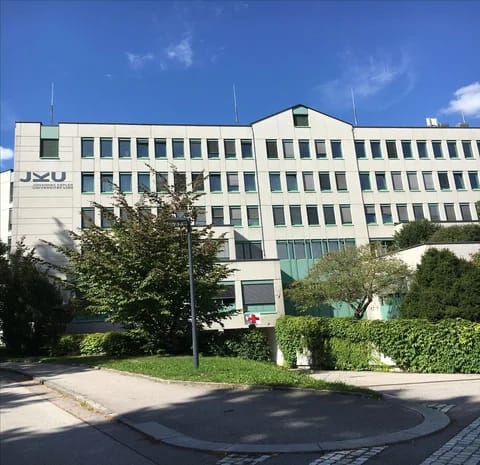
Johannes Kepler University Linz is one of the public universities in Austria. Johannes Kepler University Linz is located in Linz, the capital of Austria. The public university was the first in Austria to offer an academic degree program in computer science.
After 1953 (1954), efforts began to strengthen the business, social science and economic system here. In 1959, a board of trustees was established here where they collected funds from everyone to establish the university.
The University of Linz operates two campuses, the main campus is the JKU Auhof Campus and the other is the JKU MED Campus. Johannes Kepler University Linz currently has an enrollment of more than 24,077 students.
Johannes Kepler University Linz History
After World War II, Linz in the state of Upper Austria (Oberösterreich) in Austria was an industrialized region and its people wanted to develop the economy, social science, business / trade, and their future needed educated professionals.
After 1948, they sent a proposal to the Austrian Federal Ministry of Education, Science and Research (Bundesministerium für Bildung, Wissenschaft und Forschung, or BMBWF) to establish an engineering school, technical college, and university of technology for digitalization and digital transformation in Upper Austria, especially in Linz.
During this period, from 1950 to 1960, Heinrich Gleiner was appointed president of the university fund, during which time the university raised and saved funds. In March 1959, a separate board of trustees was established, and three years later, in 1962, the Linzer Hochschulfonds was established to save funds.\

The university was founded on October 8, 1966, under the name “Hochschule für Sozial – und Wirtschaftswissenschaften” with the faculties of economics, business, social sciences and law.
Just two days after its establishment, classes began with several students admitted to the faculties of social sciences, economics and law. In 1968, the University of Linz was merged with an academic university.
In 1969, in order to further expand the scope of its academic activities, the following faculties were established: (1) the Faculty of Natural Sciences; and (2) the Faculty of Engineering (Technisch-Naturwissenschaftliche Fakultät, or TNF).
This was the first academic degree program for students at this public university in Austria. In 1975, the university gained full status with the help of the Organization Act (UOG). The name of the university was changed from “Hochschule für Sozial- und Wirtschaftswissenschaften” to “Johannes Kepler University Linz”.
The Faculty of Law (RE) was founded at the Johannes Kepler University Linz in this year. The RE Faculty currently offers doctorate degrees, bachelor’s degrees in business and law, and more than 19 institutions are affiliated with it.
The famous German mathematician and astronomer Johanees Kepler lived and worked in Linz, Austria, for many years from 1612 to 1626. While in Linz, Johannes Kepler developed the laws of planetary motion in space.
Kepler also wrote a book called “Magnum Opus Harmonis Mundi” (Harmony of the World) while in Linz. He was known for his contributions to physics, science, astronomy, and especially mathematics, and while living in Linz, he taught mathematics at the “Adelechen Landt-Schuellen” school for the landowners there.
The university was named “Johannes Kepler University Linz” in honor of Johannes Kepler, recognizing his deep historical ties with Linz. ()
The student population continued to grow from 1980 onwards, and in 1984, the number of students exceeded 10,005 for the first time. The main library was opened here in 1984.

Then in 1985 the microelectronics lab building was built, in 1987 the “Research Institute for Symbolic Computing” (RISC) was established at JKU, later RISC was moved to Softwarepark Hagenberg.
In 1989 the Softwarepark Hagenberg and the JKU spon-off were established. In 1990 JKU became famous for introducing the first academic degree program in mechatronics in the world to advance students in the field of technology.
In 1991 the management canter was built. In 1998, the university introduced the KeplerCard, which was the first time that all students were given an Austrian electronic ID card with a chip.
In 2003 the campus-wide wireless internet access was provided, where the campus-wide access to in 2014, the university established the Faculty of Medicine (MED).
After the university separated from the federal administration in 2004 and achieved reorganized self-government with the help of a public law, the Austrian Grid Computing System was installed here, which was upgraded with the “MACH” computing system in 2011.
The MACH-2 system was then insalled in 2017. It then merged with the Kepler University Hospital, offering the first medical program in Austria, offering a medical degree program, with a master’s / bachelor’s system.
In 2016, the Linz School of Education (SoE) was established in addition to the Linz Institute of Technology (LIT). In 2016, with a focus on the future, the LIT was established for future research in various fields such as digital transformation, AI, robotics, artificial intelligence, energy, security, sustainable technologies and cyber-physical systems, and in this year the Linz School of Education (SoE) was established.

The LIT Open Innovation Center became a collaboration hub for students, researchers, and industry partners in 2019. Currently, the campus is joined by the “JKU Science Park”, an additional building for the university’s Institute of Science and Engineering.
In 2024, the university-wide “Linz Institute for Transformative Change” (i.e. LIFT_C) was launched to conduct research on sustainability, democracy, social justice, social challenges, climate, and social transformation.
Currently, JKU is the only university in Austria that offers a multimedia diploma degree program in law. Universities such as the British Open University and the German Fern University Hagen offer law degree programs and courses.
Johannes Kepler University Linz Campus
The two major campuses of JKU are described in detail below:
JKU Auhof Campus:
The JKU Auhof campus is located northeast of Linz in the Auhof area of the St. Magdalena district of Austria, surrounded by a large 36-hectare (90-acre) park-like setting of lush greenery centered around a pond, surrounded by a picturesque countryside.
The main campus of JKU, where most of the buildings of the faculties of Social Sciences, Law (RE) Economics and Business, Linz Institute of Technology (LIT), Engineering and Natural Sciences (TNF) etc. are located, is a residence for students.
It has facilities such as the central library, Juridicum Building (J), sports facilities (USI), IT services, large Mensa (cafeteria), seminar rooms, Knowledge Circus, Education Center, student residence halls and tram lines (1 and 2) for commuting.
JKU MED Campus:
The MED Campus is located in the heart of Linz, close to the Kepler University Hospital (KUK), and was established (in 2014) for the Faculty of Medicine. The MED Campus offers a modern virtual anatomy lecture hall and medSPACE for research, clinical training and teaching of medical students.
The campus is home to the Centers for Software Engineering, Computer Science, Media Technology Programs, etc., as well as the Linz Institute of Technology. Although it is located within the Auhof Campus, the MED Campus has a special emphasis on LIT’s interdisciplinary work.
Here students are provided with facilities including sports facilities (University Sports Institute – USI), main library, Science Park research building, recreation areas, various student services, residential halls for students, direct access to clinical practice and research infrastructure from the beginning of their studies. JKU’s campuses are improving one after another.
The university, which was established in 1966, currently has more than 111 institutes on its campus, and the faculties established in 1969 have also improved one after another, and currently there are more than 60 faculties, including the Faculty of Social Sciences, Faculty of Economics and Business, Faculty of Arts and Humanities, Faculty of Engineering and Natural Sciences, Faculty of Law, Faculty of Information Science, and many more.
JKU offers various types of scholarships for students, such as merit-based scholarships, social scholarships, student loans and payment plans, research scholarships, Erasmus+ scholarships, international student scholarships, and students can also find part-time jobs on campus or in Linz.